

Cass County
MNGenWeb

In 1852, James Lloyd Breck, who was then engaged in
the Indian mission work of the Protestant Episcopal church, received a call from
the Indians dwelling in the northern forests of Minnesota to go and teach them.
Obeying this call, he went to Gull Lake, in north central Minnesota, and
established there a mission station. The Indians among whom he settled were the
same people, substantially, with those who greeted the first settlers in
Virginia and with those who signed the treaty with William Penn. Breck erected
mission buildings, and a church, where he had daily service, procured female
helpers, and established schools. He also taught them to labor. Rising daily at
4 a. m., he went to the fields with the Indians, teaching them to plant, sow.
hoe, and raise all kinds of vegetables. The Indians tell how "once, when there
had been a long-continued drought, and the gardens were just on the point of
being ruined, and the sky was still brazen and cloudless as it had been for
weeks, that he rang his little bell for prayers, and summoned them all to pray
for rain; and though there was not a cloud in the sky when he began, the
dropping rain began to fall as they came out of the church, and there was a
great rain." They also tell how children who were apparently dying or dead,
revived when he knelt and prayed for them and baptized them.
Some years
later, he left his prosperous mission at Gull Lake, and established another at
Leech Lake — still deeper in the wilderness. Here, whisky flowed like water
among the Indians, supplied by the traders of mixed blood, who were incensed
against the missionaries because the latter, knowing the extortionate rates
charged by these traders for their goods, let the Indians have large quantities
of mission goods at reasonable prices, in exchange for fish, maple sugar, etc.
The hostility of the traders being thus excited, they instigated the Indians to
acts of hostility which compelled the missionaries to leave. One cause of the
failure of this mission — and perhaps of others — was that the missionaries gave
the Indians too much and thus encouraged habits of indolence and a feeling of
dependence, when a spirit of independence and self-help is essential to their
becoming well-disposed and useful citizens. After the withdrawal of the
missionaries the Indians became the prey of frontier liquor dealers and were
exposed to contact with all the vices that accompany the white man on the first
wave of civilization.
Contributed 26 Jul 2022 by Norma Hass, extracted from 1901 History of the Great Northwest and Its Men of Progress, pages 19-20.
William P. Remer filed for land in the SE 14 of Sec. 2, 141-26 on October 1, 1902. His brother Ernest was one of the pioneers of Grand Rapids. In 1905, William P. Remer was listed on the census as a forty-two year old farmer. His wife Sophia was forty-five. They had been in Minnesota for most of their lives but in Cass County for only two years. One daughter, Florence, 17 years old, lived at home. G. H. Perry described a time when he walked from Grand Rapids to the Remer area. He stayed overnight with William Remer, "who with his family lived alone in the solitude of a region where grew the tall pine trees and where the settlers were few." He spent two nights in their log cabin. During the day they walked mile after mile while they admired the lakes and the majestic trees.
By 1904, Mr. Remer's general store served a growing community and a group of the early settlers petitioned for organization of T-141-26 into the township of Willow River. B. M. Estey, Ole Halvorson, J. B. Sorum, Robert Hanson, G. H. Bergstrom, A.C. Winger, David DeCamp, Alex Gilmer, and Bert Webber signed the petition. The first town meeting was held on Saturday, October 22, 1904 at the W. T. Wilson house.
The name of Willow River lasted about a month until the citizens tried to obtain a post office by that name and learned that a post office named Willow River already existed. Therefore: "Be it resolved, by the Board of County Commissioners of Cass County, Minnesota, that the name of the town of Willow River be changed to the town of Remer by which name such township shall hereafter be designated. Dated November 15, 1904." In the first election of township officers, the following were selected.
A. C. Winger Chairman
Alex Gilmer Supervisor
R. Hanson Supervisor
W. P. Remer Clerk
B. M.
Estey Treasurer
Bert Webber Justice of the Peace
Martin Eltrich Constable
J. T. Watson Justice of the Peace
E. Sterme Constable
W. Horner Road
Overseer
At the town election two years later, an altercation occurred between W. P. Remer and W. F. Wilson, which ended with the death of W. P. Remer. William Remer was a judge of the primary election for Remer Township. W. F. Wilson was one of the clerks of the election. Sheriff Riddell and Coroner Wilcox were called by telegram to come to Remer after Mr. Remer died on September 19, 1906. The coroner and sheriff took a train from Walker to Grand Rapids and from there traveled by wagon to Remer. It appeared that Mr. Remer's death was indirectly due to excitement as a result the altercation.
Contributed by Cecelia M. McKeig, extracted from Remer, Minnesota.
Early in
October, 1898, there was an Indian battle fought at Leech Lake, in this
State, the magnitude of the result of which gives it a place in the
history of Minnesota, although it was strictly a matter of United States
cognizance and jurisdiction. In Cass county is located a Chippewa Indian
reservation, and, like all other Indian reservations, there are within
its limits turbulent people, both white and red. There is a large island
out in Leech lake called Bear island, which is inhabited by the Indians.
On October 1, 1897, one Indian shot another on this island. A prominent
member of the tribe, named Pug-on-a-ke-shig, was present and witnessed
the shooting. An indictment was found in the United States District
Court against the Indian who did the shooting, but before any trial
could be had the matter was settled among the Indians in their own way,
and they thought that was the last of it. A subpoena was issued for
Pug-on-a-ke-shig, and a deputy marshal served it. He disregarded the
subpoena. An attachment was then issued to arrest him and bring him into
court, and a deputy United States marshal tried to serve it. He was
resisted by the Indian and his friends on three different occasions, and
once when the Indian was arrested he was rescued from the custody of the
marshal. Warrants were then issued for the arrest of twenty-one of the
rescuers. This was in the latter part of August, 1898. Troops were asked
for to aid the marshal in making his arrests, and a lieutenant and
twenty men were sent from Fort Snelling for that purpose. This was
simply a repetition of the many mistakes made by the military
authorities in such matters. If troops were necessary for any purpose,
twenty men were simply useless, and worse than none, and when the time
came for the application of military force would, of course, have been
annihilated. The United States marshal with a squad of deputies
accompanied the troops. It soon became apparent that there would be
trouble before the Indians could be brought to terms, and General Bacon,
the officer in command of the Department of Dakota, with headquarters at
St. Paul, ordered Major Wilkinson, of Company E, of the Third Regiment
of United Stales Infantry, stationed at Fort Snelling, with his company
of eighty men, to the scene of the trouble. General Bacon accompanied
these troops as far as Walker, on the west bank of Leech lake, more in
the capacity of an observer of events and to gain proper knowledge of
the situation than as part of the forces. On the 5th of October, 1898,
the whole force left Walker in boats for a place on the east bank of the
lake, called Sugar Point, where there was a clearing of several acres,
and a log house occupied by Pug-on-a-ke-shig. They were accompanied by
R. T. O'Connor, the United States marshal of Minnesota, and several of
his deputies, among whom was Col. Timothy J. Sheehan, who knew the
Indians who were subject to arrest. This officer was the same man who,
as Lieutenant Sheehan, had so successfully commanded the forces at Fort
Ridgely during the Indian War of 1862, since when he had fought his way
through the Civil War with distinction. When the command landed, only a
few squaws and Indians were visible. The deputy marshals landed and,
with the inter prefers, went at once to the house, and while there
discovered an Indian whom Colonel Sheehan recognized as one for whom a
warrant was out, and immediately attempted to arrest and handcuff him.
The Indian resisted vigorously, and it was only with the aid of three or
four soldiers that they succeeded in arresting him. He was put on board
of the boat. The whole force then skirmished through the timber in
search of Indians, but found none, and about noon returned to the
clearing and were ordered to stack arms preparatory to getting dinner.
They had scouted the surrounding country and had seen no Indians or
signs of Indians, and did not believe there were any in the vicinity;
when in fact the Indians had carefully watched their every movement, and
were close to their trail, waiting for the most advantageous moment to
strike. It was the same tactics which the Indians have so often adopted
with much success in their warfare with the whites. While stacking arms
a new recruit allowed his gun to fall to the ground, and it was
discharged accidentally. The Indians, who were silently awaiting their
opportunity, supposing it was the signal of attack, opened fire on the
troops, and a vicious battle began. The soldiers seized their arms and
returned the fire as best they could, directing it at the points whence
came the shots from the invisible enemy concealed in the dense thicket.
The battle raged for several hours. General Bacon, with a gun in his
hands, was everywhere, encouraging the men. Major Wilkinson, as cool as
if he had been in a drawing room, cheered his men on, but was thrice
wounded, the last hit proving fatal. Colonel Sheehan instinctively
entered the fight, and took charge of the right wing of the line,
charging the enemy with a few followers and keeping up a rapid fire. The
Colonel was hit three times, two bullets passing through his clothes,
grazing the skin, without serious injury, and one cutting a painful, but
not dangerous wound across his stomach. The result of the fight was six
killed and nine wounded on the part of the troops. One of the- Indian
police was also killed and seven citizens wounded, some seriously. No
estimate has ever been satisfactorily obtained of the loss of the enemy.
The most reliable account of the number of his forces engaged is, from
nineteen to thirty, and if I should venture an estimate of his losses,
based upon my experience of his ability to select a vantage ground, and
take care of himself, I would put it at practically nothing.
The
killed and wounded were brought to Fort Snelling, the killed buried with
military honors and the wounded properly cared for. This event adds one
more to the long list of fatal errors committed by our military forces
in dealing with the Indians of the Northwest. They should never be
attacked without a force sufficient to demonstrate the superiority of
the whites in all cases and under all circumstances. Many a valuable
life has been thus unnecessarily lost.
Major Wilkinson, who lost
his life in this encounter, was a man who had earned an enviable record
in the army, and was much beloved by his many friends and acquaintances
in Minnesota.
The principal Indian engaged in this fight has
been called in every newspaper and other report of it
"Bug-a-ma-ge-shig," but I have succeeded in obtaining his real name from
the highest authority. The name — Pug-on-a-keshig — is the Chippewa for
Hole-in-the-day.
Shortly after the return of the troops to Fort
Snelling the settlers about Cass and Leech lakes became uneasy, and
deluged the Governor with telegrams for protection. The National Guard
or State Troops had nearly all been mustered into the United States
service for duty in the war with Spain, but the Fourteenth Regiment was
in St. Paul awaiting muster out, and the Governor telegraphed to the War
Department at Washington to send enough of them to the front to quiet
the fears of the settlers. This was declined, and the Governor at once
ordered out two batteries of artillery, all the State troops that were
available, and sent them to the scene of the troubles, and then sent his
celebrated telegram to the War Department, which may be called the
Minnesota Declaration of Independence. It ran as follows:
"October 8, 1898.
H. C. Corbin,
Adjutant General,
Washington, D. C.
No one claims that reinforcements are needed at Walker. I have not been asked for assistance from that quarter. Although I do not think General Bacon has won the victory he claims, other people do not say so. (Sic.) The Indians claim to have won, and that is my opinion. The people all along the Fosston branch of railroad are very much alarmed and asking for protection, which I have asked of the War Department. The soldiers are here and ready and willing to go, but as you have revoked your order of yesterday, you can do what you like with your soldiers. The State of Minnesota will try to get along without any assistance from the War Department in the future. D. M. Hough, Governor."
Rumor says that the telegram which was
forwarded is very much modified from that originally dictated by the
Governor.
The United States Government concluded to withdraw its
refusal and send troops to the front, and several companies of the
Fourteenth were dispatched to the line of the Fosston Branch railroad
and distributed along the line of that road.
In the meantime the
Commissioner of Indian Affairs had arrived at Walker, and was
negotiating with the Indians, and when it became known that matters were
arranged to the satisfaction of the government and the Indians, and no
outbreak was expected, the soldiers were all withdrawn, and the
incident, so far as military operations were concerned, was closed.
There were some surrenders of the Indians to the officers of the court,
but nothing further of consequence occurred.
Contributed by 2022 Jul 26 by Norma Hass, extracted from 1899 Encyclopedia of Biography of Minnesota, pages 102-104.
Iva Arvilla Morgan, age 4 months, passed away at her home August 15. Left to mourn her sudden death are her mother and father, and one sister, Elaine, also her grandmother, Mrs. H. Rux and grandfather, Mr. L. W. Morgan. Funeral services were conducted at the home of her grandfather with Rev. Chas. Fearson officiating. Burial was made in the Pine River Cemetery.
Luella Wynn, age 68, passed away August 14, at her home in Backus. Funeral services with Rev. Davis of Pequot officiating were conducted by the Northland Funeral Home. Burial was made in the Pequot cemetery.
Mrs. V. E. Dougherty and children and Miss Katherine Hoeser, sister of Mrs.
Dougherty, who have been guests at the L. E. Dougherty home, drove to
Minneapolis Thursday where Miss Hoeswer remained. Mrs. Dougherty joined her
husband, who has been in the Veterans' Hospital at Minneapolis, going from that
city to Wisconsin on a short trip. Mr. and Mrs. Dougherty and their children
arrived in Pine River on Monday to continue their visit.
Florence Kline
returned to Pine River Tuesday from a visit at the home of her sister, Mrs. John
Ackerman, in Robbinsdale, Minn.
Mr. and Mrs. Wm. Walker of Duluth arrived
Tuesday to spend a short vacation at the home of Mrs. Walker's parents, Mr. and
Mrs. B. E. Wideman.
Mr. and Mrs. Edward Finch of Minneapolis were house
guests of Mr. Finch's mother, Mrs. Theodore Hill, during the week of August
12th.
Miss Sigrid Peterson and her sister, Mrs. Millard House, of
Minneapolis, were week end guests of Mrs. Christianson of Pine River.
Mrs. John Maloney, housekeeper at the Catholic rectory had as her guests on
Sunday her two daughters, Mrs. Joe Heisler of Fargo, N. D., and Mrs. Wm.
Baldrich, of Ashland, Wis. Mrs. Maloney accompanied her daughters Monday on a
trip to Superior, Wisconsin and will return next week.
Mr. and Mrs. W. G.
Stewart and daughter Virginia were Thursday dinner guests at the home of Judge
and Mrs. B. F. Wright at Park Rapids. Present also was Mrs. Grover O'Connell of
Boston, Mass., daughter of Judge and Mrs. Wright, and sister-in-law of Mrs.
Stewart. Mrs. O'Connell accompanied by her young son Tommy, is spending a few
weeks at her parent's home.
Mrs. Edward Crimmins of Pequot gave birth to
a baby boy, August 20th. Mother and baby are doing fine.
A seven and a
half pound baby boy was born to Mr. and Mrs. L. Knott of Pine River at the
Holman hospital, August 16.
Mrs. E. A. Erickson left Pine River Wednesday
morning for Minneapolis where she will spend several days as a guest of her
sister, Miss Selma Barnes.
Mr. and Mrs. Dave Triggs and family left Pine
River Friday morning to drive to Croton, S. D., home of Mrs. Triggs' parents.
They returned to Pine River Monday morning.
Mr. and Mrs. E. G. Haymaker
of Motley were Sunday guests at the home of Mrs. Haymaker's sister, Mrs. Clyde
Townsend. They also called on friends at Norway Lake.
Martin Erickson's brother of Boy River drove down for a week end
visit.
Alice Secord left last Wednesday for Detroit, Michigan, after
spending the summer at the home of her parents, Mr. and Mrs. J. S. Rice.
Mrs. Hans Hanson enjoyed a visit with her daughter and husband, Mr. and Mrs.
Frank Cosett.
Mrs. Offa Thompson and baby son returned home from the Pine
River Hospital Saturday.
The Fred Henderson family of Avant, Okla., is
visiting at the home of her brother, Milton Coon.
Mr. Stump of Nebraska
purchased the farm occupied by the Wilson Kramer family, he expects to move on
it next spring.
A. J. Hiles and family from Loveland, Iowa, arrived last
week. They have purchased the "Old Baily farm" and expect to erect a new set of
farm buildings. At present they are staying with the W. E. Hiles family.
Mrs. D. Riley and daughters are making their
home with her sister, Emma Houston, while Mr. Riley is at work in the harvest
fields in North Dakota.
The little baby boy born to Mr. and Mrs. Harold
Moser the ninth of August has been named Keith Harold.
Extracted 2022 Jan 12 by Norma Hass
Photos taken by his great-uncle Loe Olds were submitted by Steven Olds.

Loe Olds
at his cabin near Mae

Beulah Township Board
Left to Right: Jenkins, Robinson, Stratton, and Loe Olds

"Cyclone Express
in the Far North"
possibly near Mae at Egg Lake

"One Hour's Fishing"
Sep 1911 at Egg Lake
Rufus Fleming

"The Season's Bag"
Nov 1911
Burt Olds, son of Loe, on left

"Deer Hunting"
Nov 1911
near Mae
Remer photos were submitted by Minnesota Historical Society. The people were identified by Esther (Pound) Anderson White.

Bethany Lutheran Church
Confirmation Class of 1932
Back Row, Left to Right: Unknown, Ruth Backstrom, Unknown, Raymond Fanth, Oscar Sorum, Unknown, Unknown, Harold Backstrom, Margaret Edlund, Effie Sorum
Front Row, Left to Right: Evelyn Satterstrom, Unknown, Reverend Gunderson, Elsie? Eklund, Unknown, Florence Satterstrom

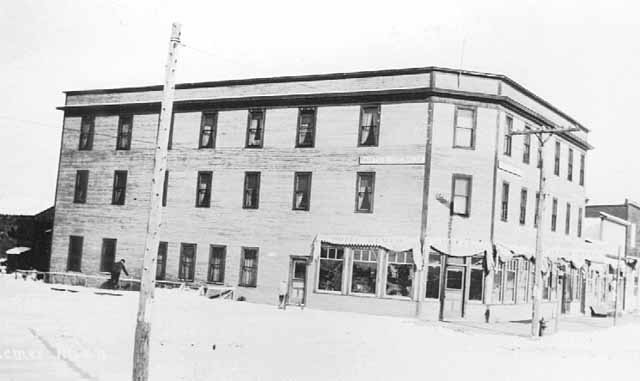
Remer Hotel
1910
1925

Depot agent Ed Trombly standing by an out-going shipment of
Hicks Wild Rice at the
Remer Soo Line Depot circa late 1920s to early 1930s

German Prisoner of War Camp
1944


Residence on Big Sand Lake near Remer

Remer
1964

Remer
1964
Pillager photos were submitted by Lori Hardow.

Hardow Family Home
in Sylvan Township, Pillager
around 1910

Hulda, Clara, Joseph, Lars, and Franz Hardow

Pillager School about 1907
Martin, Louise, and Anna Gerrels marked in red

First Pillager School
circa 1907

Pillager School
built circa 1913
demolished circa 1990

Pillager Train Station
1836
Standing: George Gerrels, Anna Gerrels Hardow, Martin Gerrels, Frances Hardow, William Gerrels, Ethel Bingham Gerrels, Anna Berndt Gerrels, Herman Gerrels, Dorthy Berndt, Margaret Dilley Gerrels
Kneeling Adults: Louise Gerrels, Hilda Rupp Gerrels
Children: Beatrice, Audrey, Elwanda, Elsworth, Wilbur, Judy, & Leota Gerrels
Copyright © 1996- The USGenWeb® Project, MNGenWeb, Cass County

This page was last updated
07/23/2026